Struggling for Sales? WhatsApp Business Automation Ideas to Boost Revenue
WhatsApp Business Automation: revenue optimization configurations
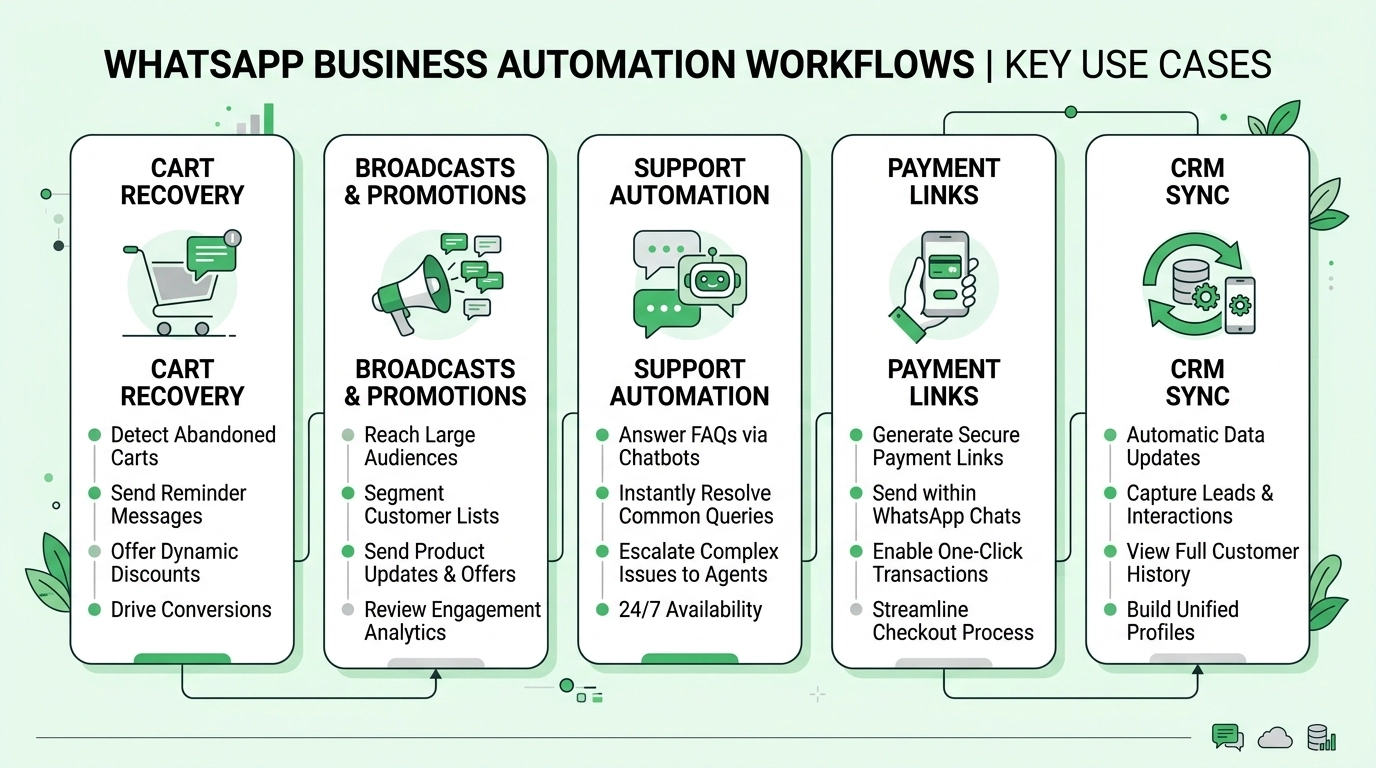
Automated Cart Abandonment Recovery
Configuration: Triggered via API integration when a customer leaves the checkout page without completion. This setup typically monitors session exits, incomplete checkout states, and cart value thresholds to determine when a recovery sequence should begin.
Functionality: Sends a automated WhatsApp message within 15-60 minutes of session termination. The message can include abandoned product details, a cart link, incentive messaging, and reminder logic based on customer behavior.
Integration: Shopify integration or custom API hooks. It can also connect with catalog data and order systems to ensure message accuracy and real-time cart content visibility.
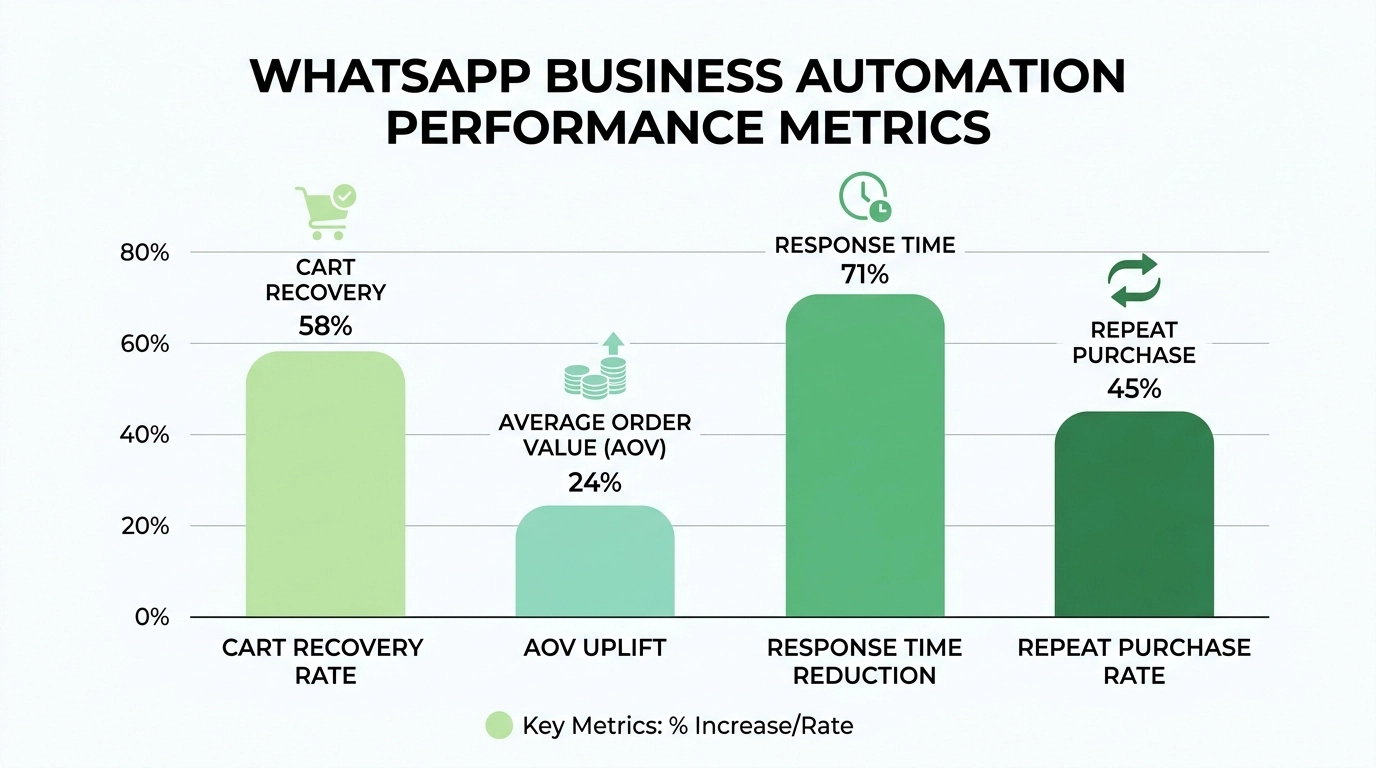
Metric focus: 45-60% recovery rate; direct impact on daily revenue. This makes it one of the highest-priority automations for ecommerce teams focused on conversion recovery and low-friction re-engagement.
AI-Driven Personalized Product Recommendations
Configuration: Data-driven automation utilizing browsing history and previous purchase metadata. This workflow uses customer attributes, browsing depth, prior orders, and interest signals to determine recommendation relevance.
Functionality: AI agents analyze customer behavior to send relevant product links directly to the chat. Recommendations may include complementary items, bestsellers in a viewed category, replenishment options, or premium alternatives.
ROI impact: Up to 30% increase in average order value (AOV) through WhatsApp chatbot workflows. It also improves product discovery and supports a more guided buying process.
Bulk Marketing Broadcasts
Configuration: Segmented audience list deployment using WhatsApp Business API. Lists can be grouped by purchase behavior, location, campaign source, customer lifecycle stage, or product interest.
Functionality: Synchronous delivery of promotional assets, discount codes, and seasonal updates. Broadcasts can be scheduled, personalized, and linked to campaign tracking for better optimization.
Utility: Unlimited message delivery to opted-in contact lists without account restriction. This supports sale announcements, product launches, festive campaigns, and retention messaging at scale.
Automated Back-in-Stock Notifications
Configuration: Inventory-triggered automation linked to SKU availability. The workflow activates when stock status changes and cross-checks subscriber interest against the updated inventory feed.
Functionality: Immediate notification to customers who previously engaged with or requested alerts for out-of-stock items. Messages can include product images, variant details, and direct purchase links.
Goal: Immediate sales conversion for high-demand inventory. This is particularly useful for limited-stock products, repeat-demand items, and fast-moving categories.
Subscription-Based Replenishment Campaigns
Configuration: Time-delayed triggers based on the average consumption cycle of specific products. Rules can vary by SKU type, reorder history, and customer frequency pattern.
Functionality: Automated reminder messages sent (e.g., 30 or 60 days post-purchase) with a one-click re-order link. These reminders can include bundle suggestions or subscription upgrade prompts.
KPI: Customer lifetime value (CLV) optimization. The workflow supports recurring revenue by reducing churn between purchase cycles.
Flash Sale and Limited-Time Offer Alerts
Configuration: Scheduled automation for high-velocity sales events. These alerts are commonly tied to campaign calendars, inventory pressure, or short-duration promotional windows.
Functionality: Real-time distribution of time-sensitive coupons and countdown-based promotional graphics. They can be segmented by customer intent, purchase history, or geography for sharper campaign targeting.
Immediate Transactional Confirmations
Configuration: Post-payment automation via webhook triggers. The system detects successful payment events and instantly initiates confirmation delivery.
Functionality: Delivery of digital receipts, order summary PDFs, and payment status updates. These confirmations create a clear post-purchase record and reduce uncertainty after checkout.
Impact: Reduction in inbound support queries regarding payment validation. It also strengthens trust by maintaining consistent transaction visibility.
Real-Time Shipping and Logistics Updates
Configuration: Automated workflow linked to courier API or e-commerce fulfillment status. It synchronizes shipment milestones from dispatch through final delivery.
Functionality: Push notifications for ‘Order Dispatched’, ‘In Transit’, and ‘Out for Delivery’. Messages can also include ETA ranges, tracking pages, and exception alerts.
Status: Provides transparent tracking links within the WhatsApp interface. This reduces anxiety during the fulfillment stage and lowers tracking-related support load.
Direct In-App Product Browsing
Configuration: WhatsApp catalogue synchronization. Product feeds are mapped into chat-ready formats for direct browsing without switching channels.
Functionality: Interactive product displays with high-resolution imagery and detailed specifications directly in the chat window. Businesses can present variants, pricing, and availability in a more frictionless format.
User flow: Discovery to cart addition without external browser redirection. This compresses the purchase journey and supports quicker decision-making.
24/7 Automated FAQ Support
Configuration: Keyword-based or LLM-powered chatbot workflows. The system maps common customer intents to preconfigured answers, guided paths, or escalation triggers.
Functionality: Instant resolution for common queries (e.g., return policy, shipping costs, location). It can also capture context before transferring the conversation to a live agent.
Benefit: 0% response delay for standardized customer inquiries. This improves service continuity across working and non-working hours.
Post-Purchase Satisfaction Surveys
Configuration: Delivery-triggered automation sent 24-48 hours post-fulfillment. This timing allows customers to evaluate both delivery experience and early product satisfaction.
Functionality: Collection of CSAT or NPS scores through interactive buttons or quick-reply options. Surveys can also request optional feedback comments for deeper analysis.
Data utility: Qualitative feedback loops for product and service improvement. These insights help teams identify service gaps, product concerns, and loyalty signals.
AI Shopping Assistance
Configuration: Intelligent workflow automation for guided selling. The flow uses customer responses, preferences, and purchase intent to narrow down relevant options.
Functionality: Conversational interface that identifies customer needs through structured questioning and recommends matching SKUs. It works well for categories with broad catalogs or high decision complexity.
Platform requirement: WhatsApp automation. This setup can support product education, upsell paths, and assisted conversion journeys.
Multi-Agent Customer Support Dashboard
Configuration: Unified inbox for large-scale team management. All inbound conversations are centralized so teams can route requests by department, urgency, or issue type.
Functionality: Real-time ticket assignment, supervisor monitoring, and multi-user login under a single WhatsApp number. This allows operational control without fragmenting the customer experience.
Utility: Enterprise-level scalability for WhatsApp customer support. It is useful for growing teams handling high chat volumes across sales and service functions.
Automated Payment Link Generation
Configuration: Payment gateway integration (Stripe, Razorpay, PayPal). Payment workflows are connected to order state, cart amount, and customer identity.
Functionality: Generation and delivery of secure payment links directly within the chat for instant conversion. This is effective for assisted selling, order confirmation, and manual checkout recovery.
Outcome: Frictionless checkout experience. It reduces the number of steps between conversation and payment completion.
WhatsApp Store Functionality
Configuration: End-to-end commerce setup. The store environment combines product display, order intake, customer detail capture, and payment enablement inside one channel.
Functionality: Integration of cart management, address collection, and payment processing within the WhatsApp environment. This reduces handoffs and keeps the buyer journey operationally simple.
Requirement: WhatsApp store module. It is suited for brands that want conversational commerce rather than redirect-heavy checkout flows.
Re-engagement Campaigns for Inactive Users
Configuration: Triggered for accounts with zero interaction for 90+ days. Criteria can also be adjusted based on order value, category interest, or previous campaign response.
Functionality: Automated “We miss you” messaging with exclusive incentive codes. The workflow may include reminder sequences, time-bound offers, or personalized product prompts.
Objective: Reactivation of stagnant customer databases. This helps improve retention efficiency without relying only on acquisition efforts.
Automated Loyalty and Rewards Notifications
Configuration: CRM-linked automation. The loyalty engine tracks customer actions and sends updates when thresholds, milestones, or expiration events are reached.
Functionality: Real-time alerts for earned points, tier upgrades, and expiring rewards. Messages can also include redemption prompts or targeted reward reminders.
System: Keeps loyalty programs top-of-mind for repeat buyers. It supports stronger repeat purchase behavior and better reward visibility.
Lead Qualification and Capture
Configuration: Click-to-WhatsApp ad landing page integration. The workflow begins when a prospect clicks an ad and enters a preconfigured chat flow.
Functionality: Automated initial greeting and data collection (name, email, preference) from new prospects. Qualification logic can sort leads by intent, product interest, budget, or urgency.
Marketing tech: Optimization of Click-to-WhatsApp ad spend. It improves lead handling speed and makes ad traffic more conversion-ready.
Seamless CRM Data Synchronization
Configuration: Bidirectional data flow between WhatsApp and third-party CRMs (HubSpot, Salesforce). The sync layer ensures customer actions are reflected across both communication and record systems.
Functionality: Automatic logging of conversation history and contact details to a central database. This supports better sales visibility, campaign tracking, and service continuity.
Compliance: Ensures data integrity across marketing and sales teams. It also reduces manual data entry and operational duplication.
E-commerce API Integration (Shopify, WooCommerce, Wix)
Configuration: Native plugin or API connection. The connection links store data, order flow, inventory changes, and customer actions with WhatsApp messaging logic.
Functionality: Real-time inventory synchronization and automated order state management. This allows business teams to build accurate automations using live commerce data.
Visual Asset: Standard product packaging and benefits display. It forms the technical base for product sharing, checkout support, notifications, and campaign triggers.
Comparison Table
| Use Case | Primary Function | Integration Need | Business Outcome |
|---|---|---|---|
| Cart Recovery | Recover incomplete purchases | Shopify or custom API | Revenue recovery |
| Product Recommendations | Suggest relevant products | Customer data and chatbot workflow | Higher AOV |
| Broadcast Campaigns | Send promotional campaigns at scale | WhatsApp Business API | Wider campaign reach |
| Back-in-Stock Alerts | Notify interested customers instantly | Inventory sync | Faster sales conversion |
| FAQ Automation | Resolve common support queries | Chatbot workflow | Lower response time |
| Multi-Agent Support | Manage support across teams | Shared inbox setup | Better support operations |
| Payment Links | Send checkout-ready payment requests | Payment gateway integration | Faster conversion |
| CRM Sync | Update customer records automatically | HubSpot, Salesforce, or CRM API | Centralized customer data |
FAQ
What is WhatsApp business automation?
WhatsApp business automation is the use of workflows, chatbots, triggers, and API-based messaging to automate sales, support, and customer engagement on WhatsApp.
How does WhatsApp automation help increase revenue?
It helps recover carts, send product recommendations, automate follow-ups, and reduce response delays, which can improve conversions and repeat purchases.
Do businesses need WhatsApp Business API for automation?
Yes. Advanced automation, broadcasts, CRM sync, and system integrations typically require WhatsApp Business API access.
Can WhatsApp automation work with ecommerce platforms?
Yes. It can connect with Shopify, WooCommerce, Wix, and other platforms for order updates, cart recovery, inventory sync, and product sharing.
Is WhatsApp automation useful for customer support?
Yes. It can automate FAQ replies, assign chats to agents, send status updates, and support multi-agent workflows.
© 2026. All Rights Reserved. Confidential and Proprietary Information. No part of this publication may be reproduced or distributed without prior written permission.

Adam Wilson
Adam Wilson comes with an experience of 12+ years in the IT industry. As a Customer Success Manager, he has been researching and trying to understand the customers’ behavior in different scenarios. He has also studied human psychology to relate it to the purchase journey of the customers. His published books on customer psychology and behavior have received many honors and awards from various enterprises.