The Proven WhatsApp ROI Framework: How to Turn Chats into Trackable Revenue
Let’s be real: WhatsApp marketing is the "shiny new toy" that every e-commerce and retail founder is chasing right now. And for good reason, 98% open rates make email look like a fossil. But there’s a trap. A lot of brands are sending broadcasts into the void, seeing "seen" receipts, and crossing their fingers that it results in sales.
If you can’t track your WhatsApp revenue down to the cent, you’re not marketing; you’re just chatting.
In this guide, we’re moving past "vanity metrics" and diving into a hard-hitting ROI framework. I’ll show you exactly how to build a trackable funnel that turns casual pings into cold, hard cash, and how to use the right metrics to scale your business with confidence.
Summary
This article outlines a strategic framework for measuring and maximizing WhatsApp ROI. We cover the shift from engagement metrics (opens/reads) to financial metrics (CPA, AOV, and CLV). You'll learn how to implement deterministic sales attribution using WhatsApp Business API, track conversions with UTMs and CRM syncing, and leverage WhatsApp automation to slash operational costs while boosting revenue.
Table of Contents
- The "Black Box" Problem of WhatsApp ROI
- The 3-Layer ROI Metric Pyramid
- Attribution: How to Link Chats to Checkouts
- Maximizing ROI with WebMaxy's Automation & Analytics
- A Real-World Calculation Example
- Conclusion
- Frequently Asked Questions
1. The "Black Box" Problem of WhatsApp ROI
For most founders, WhatsApp feels like a black box. You know customers are talking to you. You know you’re sending out WhatsApp campaigns. But when the monthly revenue report hits, it’s hard to tell if that 20% spike came from your latest broadcast or an organic Instagram post.
To fix this, we need to stop treating WhatsApp as a support channel and start treating it as a performance marketing channel.
Traditional ROI calculation is simple: (Revenue – Cost) / Cost x 100. The challenge is defining those two variables specifically for WhatsApp. "Cost" isn't just the platform fee; it's the message templates, the agent's time, and the automation setup. "Revenue" isn't just direct sales; it's the assisted conversions where a quick chat about sizing led to a purchase two days later.

2. The 3-Layer ROI Metric Pyramid
To build a sustainable framework, you need to track metrics at three different depths.
Layer 1: Engagement (The Leading Indicators)
These tell you if your audience is actually listening.
- Read Rate: Usually 80%+. If it's lower, your opt-in quality is poor.
- Click-Through Rate (CTR): Are your WhatsApp catalogue links compelling?
- Response Rate: High responses mean your content is conversational, not just spammy.
Layer 2: Conversion (The Revenue Drivers)
This is where the money starts moving.
- Conversion Rate: The % of people who receive a message and complete a goal (purchase, demo, etc.).
- Cost Per Acquisition (CPA): Total WhatsApp spend divided by new customers acquired.
- Average Order Value (AOV): Are WhatsApp customers spending more than your email or web-only customers? (Hint: They usually are).
Layer 3: Lifetime Value (The Scale Metrics)
This is the "Holy Grail" of ROI.
- Customer Lifetime Value (CLV): Use WhatsApp to drive repeat purchases via automated restock reminders.
- Retention Rate: Tracking how many customers buy again within 30-60 days of a WhatsApp interaction.
3. Attribution: How to Link Chats to Checkouts
Tracking is where most brands fail. If you aren't using a multi-agent dashboard or a dedicated API platform like WebMaxy, you’re flying blind.
Here is the "Proven Attribution Stack":
- UTM Tagging for Every Link: Never send a bare URL. Every link in your WhatsApp store or broadcast should have a UTM parameter (e.g.,
utm_source=whatsapp&utm_campaign=summer_sale). This allows your Google Analytics or Shopify dashboard to see exactly which sales originated from your chats. - Deterministic Tracking via Message IDs: When a customer clicks a button in a WhatsApp flow, WebMaxy tags that user with a specific campaign ID. Even if they don't buy immediately, their user profile in your CRM now carries the "WhatsApp-engaged" tag.
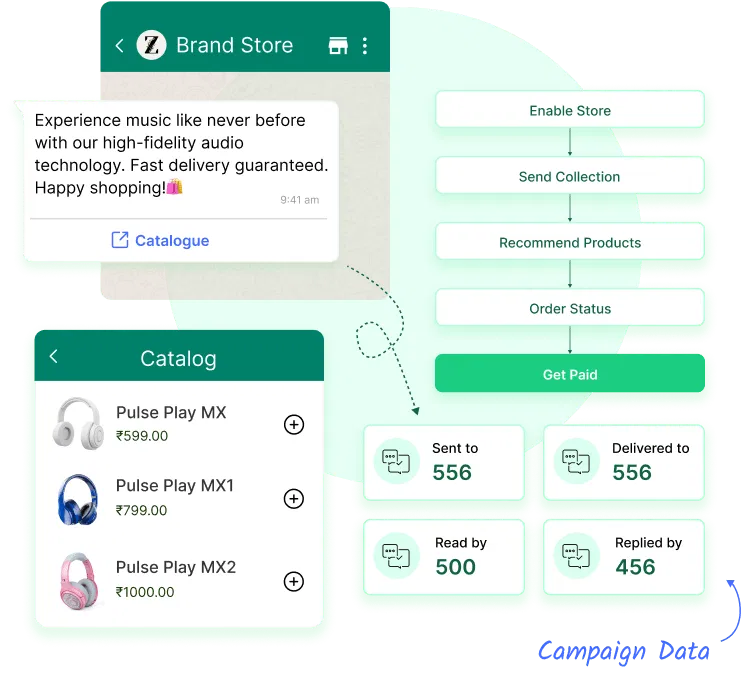
- Direct Sales via In-Chat Payments: The shortest path to ROI is keeping the customer inside the app. By integrating payment gateways, you can track "Direct Revenue" that never even hits your website, providing 100% accurate attribution.
4. Maximizing ROI with WebMaxy's Automation & Analytics
ROI isn't just about making more money; it's about spending less to get it.
If your human agents are manually answering "Where is my order?" 50 times a day, your labor costs are eating your ROI. WebMaxy helps you flip the script:
- AI Chatbots: We help you automate up to 80% of FAQs. This drives the "Cost" side of the ROI equation down significantly.
- Click-to-WhatsApp Ads: Stop sending Facebook traffic to a landing page where 70% of people bounce. Send them directly into a Click-to-WhatsApp Ad flow. The conversion rates are often 3-5x higher because you capture their phone number (lead generation) the second they message you.
- Abandoned Cart Recovery: This is the highest ROI automation you can run. A simple automated WhatsApp reminder for an abandoned cart can recover up to 25% of lost revenue, often at a fraction of the cost of retargeting ads.

5. A Real-World Calculation Example
Let's look at a typical SME brand using the WebMaxy framework:
- Monthly WhatsApp Cost: $500 (Platform + Meta message fees).
- Campaigns Sent: 5,000 messages.
- CTR: 20% (1,000 clicks).
- Conversion Rate on Clicks: 10% (100 sales).
- AOV: $60.
- Total Revenue: $6,000.
ROI Calculation:
($6,000 Revenue – $500 Cost) / $500 Cost = 1,100% ROI.
When you see numbers like that, it becomes very easy to justify shifting budget away from lower-performing channels like cold email or display ads.
6. Conclusion
The businesses that will win in the next five years aren't the ones with the biggest ad budgets; they're the ones with the best relationships. WhatsApp is the most intimate, direct relationship you can have with a customer.
By applying this ROI framework, focusing on attribution, layering your metrics, and aggressively using WhatsApp automation, you turn a "chat app" into your most profitable sales representative.
Stop guessing. Start tracking. And if you’re ready to see the numbers for yourself, WebMaxy’s analytics dashboard is built to show you exactly where your revenue is coming from.
Frequently Asked Questions
Q1: How do I track offline sales from WhatsApp?
You can use unique QR codes for in-store purchases that trigger a WhatsApp welcome message. By tagging these users in your CRM, you can track their future purchase history back to that initial offline-to-online touchpoint.
Q2: What is a "good" conversion rate for WhatsApp?
While it varies by industry, most e-commerce brands see a 5–15% conversion rate on dedicated promotional broadcasts, which is significantly higher than the 1–3% average for email marketing.
Q3: Can I track ROI without using the WhatsApp Business API?
It’s nearly impossible to do at scale. The standard WhatsApp Business App lacks the analytics, automation, and multi-user tracking required to link chats to specific sales events and CRM data.
Q4: How does automation impact ROI?
Automation primarily improves ROI by reducing "Cost per Lead." By handling initial qualifications and FAQs without a human agent, you lower your overhead while ensuring 24/7 engagement, which also boosts conversion rates.
Q5: Is it possible to see which specific WhatsApp campaign led to a sale?
Yes. By using WebMaxy’s campaign dashboard, you can see the delivery, read, and conversion stats for every individual broadcast you send, allowing you to double down on what works and kill what doesn’t.

Adam Wilson
Adam Wilson comes with an experience of 12+ years in the IT industry. As a Customer Success Manager, he has been researching and trying to understand the customers’ behavior in different scenarios. He has also studied human psychology to relate it to the purchase journey of the customers. His published books on customer psychology and behavior have received many honors and awards from various enterprises.