The Rise of AI Agents: Why Automation is Getting a Brain Upgrade in 2026
AI AGENTS: FROM AUTOMATION TO AUTONOMY
AI agents are changing what automation actually means. For years, businesses relied on rule-based systems and RPA to handle repetitive work through fixed instructions, triggers, and predefined workflows. That worked well for structured tasks, but it also meant the system could only do what it was explicitly told to do.
Now the shift is toward autonomous, goal-oriented systems that can understand context, reason through different possibilities, and take action with far less human input. Instead of just following an if/then path, AI agents can interpret intent, decide the next best step, pull information from connected tools, and move a task toward an outcome.
In simple terms, RPA follows rules. AI agents pursue goals. That is what makes them more useful for modern customer conversations, fast-moving business operations, and channels like WhatsApp Business API, where users expect quick, relevant, and natural interactions.
Traditional Automation Limitations
- Static execution: Systems follow pre-defined “if/then” logic strings.
- Fixed workflows: Inability to adapt to non-linear customer inquiries.
- Manual dependency: Significant human intervention required for context resolution.
- Data silos: Limited interaction between disconnected software stacks.
AI AGENTS: SYSTEM CAPABILITIES
AI agents represent a goal-oriented architecture. Systems analyze WhatsApp automation data to identify intent rather than just keywords.
- Contextual Awareness: Retention of conversation history for persistent user journeys.
- Autonomous Decisioning: Real-time selection of resolution paths based on live database queries.
- Tool Interaction: Direct execution of actions across integrated platforms (e.g., Shopify, WooCommerce).
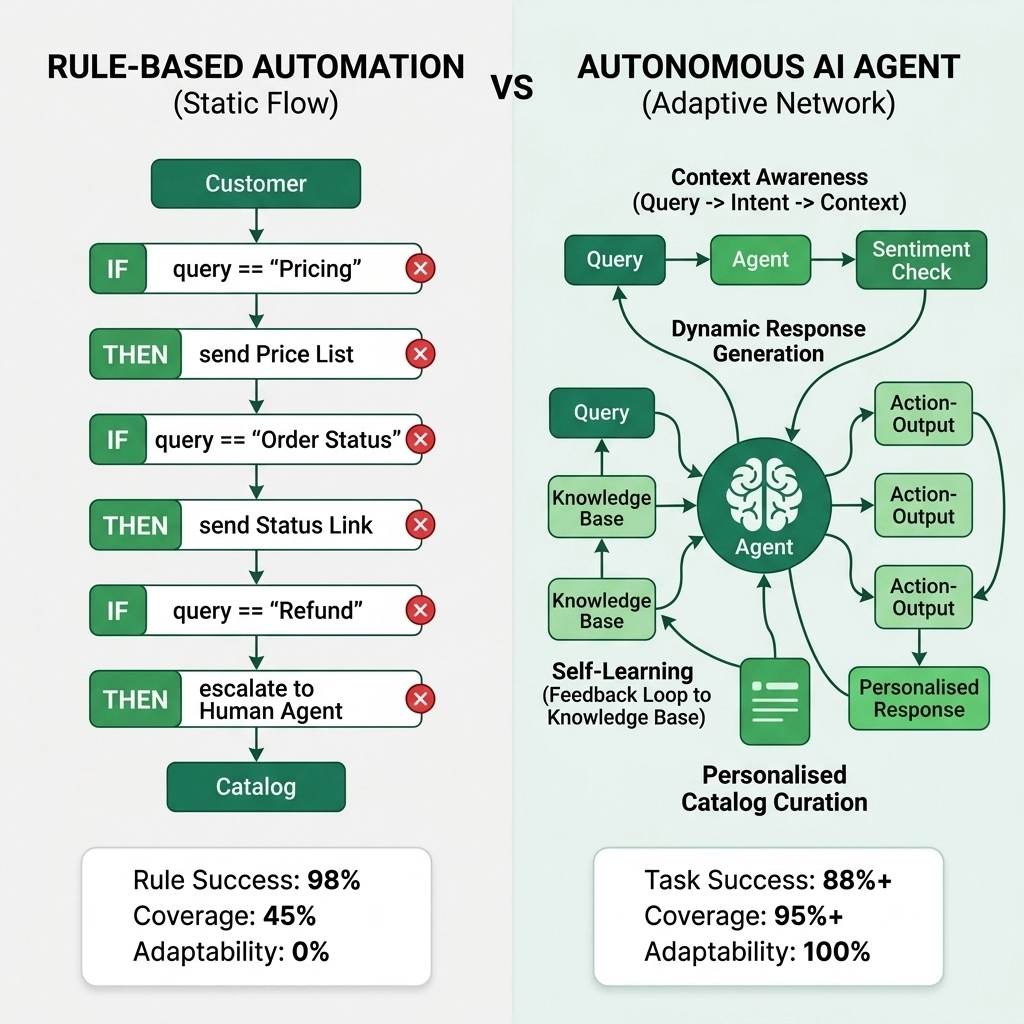
Comparison: Traditional Systems vs AI Agents
| Feature | Traditional Automation | AI Agents |
|---|---|---|
| Operational Role | Assist humans | Act autonomously |
| Logic Base | Follow rules | Adapt to context |
| Primary Output | Execute tasks | Own outcomes |
| Supervision | Require constant oversight | Operate independently |
Functional Value Areas
Customer Operations
Resolution of queries and issue management via WhatsApp chatbot for business. 24/7 availability without human latency.
Process Automation
Management of end-to-end workflows. Integration of WhatsApp catalogue for automated product selection and checkout.
Internal Productivity
Reduction of repetitive administrative tasks. Automated lead qualification and multi-agent routing within a centralized dashboard. Some businesses also integrate an AI-powered ATS (e.g., Manatal) to streamline hiring workflows alongside these operations.
AI AGENT USE CASES ACROSS INDUSTRIES
E-Commerce
AI agents on WhatsApp can act like personalized shopping assistants that do much more than recommend products. They can understand customer preferences, answer detailed product questions, compare options, recover abandoned carts, share items through a WhatsApp catalogue, and guide the buyer all the way to checkout. Instead of waiting for manual support, the agent can manage the full shopping journey autonomously, powered by advanced retail AI agent development that enables seamless, personalized, and real-time customer experiences.
Real Estate
In real estate, AI agents can qualify leads, ask budget and location-related questions, recommend suitable properties, schedule site visits, and share virtual tour links directly on WhatsApp. They can also follow up automatically based on buyer interest and conversation history, helping agents focus only on high-intent prospects.
Healthcare
Healthcare teams can use AI agents to handle appointment scheduling, rescheduling, reminders, patient intake questions, and post-visit follow-ups. On WhatsApp, these agents can coordinate routine communication autonomously while keeping conversations organized and responsive, especially for high-volume clinics and service providers.
Travel
For travel businesses, AI agents can help customers discover packages, suggest destinations, confirm bookings, send travel updates, and manage itinerary changes in real time. On WhatsApp, they can handle multi-step requests autonomously, which is especially useful when travelers need quick support before or during a trip.
BUSINESS IMPACT
AI agents do more than automate replies. They improve business impact in ways that are easy to measure. By handling conversations, recommendations, follow-ups, scheduling, and support tasks autonomously on WhatsApp, they reduce manual workload and speed up customer-facing operations.
That leads to stronger ROI through lower operational costs, better team efficiency, and higher conversion rates. Businesses can support customers 24/7 without adding round-the-clock staffing, which improves response times and overall customer satisfaction. When AI agents consistently move leads, shoppers, and service requests toward resolution, they also help unlock new revenue opportunities that traditional automation often misses.
WebMaxy AI Integration
WebMaxy provides a specialized whatsapp business automation framework for SMEs and Enterprises.
- Autonomous Chatflows: Goal-oriented conversation paths.
- E-commerce Sync: Direct WhatsApp Store integration for Shopify and Magento.
- Ad Optimization: Integration with Click-to-WhatsApp Ads for seamless lead handling.
- Hybrid Handoff: Intelligent routing to human agents for complex escalations.
If you want to deploy AI agents on WhatsApp without stitching together multiple tools, WebMaxy gives you everything in one place. From AI-powered chatbots and automated journeys to seamless CRM and commerce integrations, WebMaxy helps businesses create smarter customer conversations and unlock up to 60% revenue growth.
Ready to turn WhatsApp into an autonomous sales and support channel? Explore WebMaxy and see how your business can scale faster with AI agents built for real customer engagement.
Implementation Considerations
- System Integration: Alignment with existing legacy infrastructure.
- Data Governance: Ensuring quality and compliance in automated handling.
- Workforce Adaptation: Shifting human focus to strategic, high-value operations.

Conclusion
The shift from automation to autonomous agents is a major step forward for businesses using WhatsApp. Traditional systems were built to follow instructions. AI agents are built to understand goals, adapt to customer context, and take meaningful action across complex workflows.
Looking ahead, the businesses that grow faster will be the ones that adopt systems capable of reasoning, responding, and executing across the full customer journey. AI agents are not just an upgrade to automation. They are becoming the new operating layer for scalable customer engagement on WhatsApp.
If your business is ready to move beyond basic automation and deploy smarter, revenue-focused AI agents, now is the time to act. Explore WebMaxy and start building more autonomous customer experiences on WhatsApp today.
Copyright © 2026 WebMaxy. All Rights Reserved.

Adam Wilson
Adam Wilson comes with an experience of 12+ years in the IT industry. As a Customer Success Manager, he has been researching and trying to understand the customers’ behavior in different scenarios. He has also studied human psychology to relate it to the purchase journey of the customers. His published books on customer psychology and behavior have received many honors and awards from various enterprises.