Automated Sales Funnel: A Need for your Startup’s Growth in 2026
Business cycle for Startups is quick. The customer expectations to be catered in time. They also fast feedback. But the issue with Startups are they have less manpower. To attain customer query and start with conversation immediately, but if the customers or enquiries goes on increasing, startup staff can handle on manual mode up to some limits. After that, processes start to fall. Here, WhatsApp API with automated sales funnel can play the key role.
Let us throw some light on how WhatsApp Business Api help these startups in their automated sales funnel.
Ideally, they help in:
- Leads qualification
- Send instant replies with templates and automation
- Seriously diverts to WhatsApp Business Calling from the same inbox
- Run onboarding and support journeys with your available team
Let us see why startups need automated sales funnel to improve their businesses via WhatsApp in the upcoming section in this blog.
Importance of Automated Sales Funnel via WhatsApp
In the earlier stages of a startup business, teams move fast, but their customer conversations do not come along.
A few common issues come across:
- Leads arrive from ads, your website, and social channels at any time.
- Replies as ‘slip’ status when the team is in meetings or working on a product.
- Qualification relies on who picks up the chat first.
- Support questions disturb sales conversations.
- Tracking happens across Google Sheets, inboxes, and DMs.
Connecting with a lead within the first 5 minutes improves conversion rates by up to 8x, as per Inside Sales report, which is nearly impossible to achieve manually. But automation fill up this gap by replying every time with promptness.
With the use of automation, startups automate their regular steps and make their human teams free for more revenue-driven tasks.
An easier path starts to form:
A user clicks an ad > goes to WhatsApp > answers a few qualification questions > gets the correct next step > books a call / gets a recommendation > activates their account > and acquires support when required.
This removes the hassle between “interest” and “action”. Your team focuses on real opportunities rather than the inbox management.
The WhatsApp API supplies the main messaging functions. Platforms like WebMaxy add the inbox, automation, and integration layers need to run these workflows.
Making Your own Automated Sales Funnel
An automated WhatsApp funnel works best when you break it into simple, practical stages. Each stage has a clear job and moves the user towards a decision.
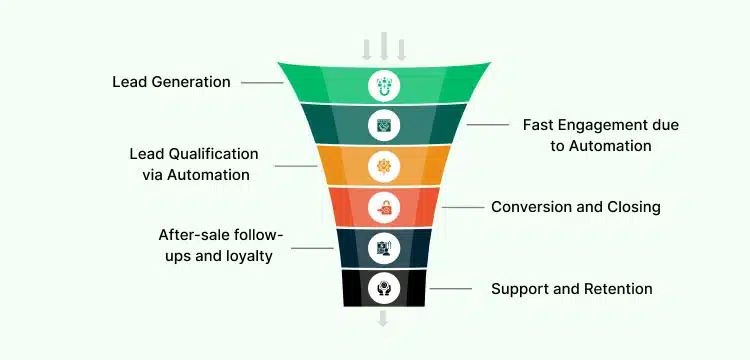
Stage 1: Lead Generation
Use CTWA to Cover Up the Top of Your Automated Sales Funnel
Click-to-WhatsApp ads start makes it easy to turn attention into a live chat. People avoid the forms and go direct to WhatsApp, where you can start supporting them promptly. This is useful for startups needing steady, high-intent conversations without extra effort.
WebMaxy supports CTWA-style flows across Google, Facebook, Instagram and TikTok.
An easy flow looks like this:
Ad click > WhatsApp starts > automated welcome > team notification sent > campaign data logged
You get a direct line from the ad to the conversation, making your funnel easy to track and scale.
Example:
A D2C beauty brand runs TikTok ads opening WhatsApp using the CTWA setup. When someone taps the CTA, the lead appears in the inbox with practical context – Ad set name, Campaign ID and Tracking parameters added to the link.
The system sends the first message automated and alerts the team. There is no manual export or sorting, and users don’t wait for a reply.
Please note that, for different products, if any business needs to run independent campaigns, then it must go for different number each time.
The team can work from single dashboard, with different product journeys carried out with different WhatsApp Business numbers product wise.
- Build Zero-Friction Entry Points Beyond Ads
People must be able to reach you from the places they already interact. When the path to WhatsApp is clear, more conversations start. - One can compose it like below flow:
Add a WhatsApp button to your site for conversations>>Print QR codes on receipts, packaging or display stands>>Place a WhatsApp link in your Instagram bio>>Add a shorter link for your email signature>>Use QR codes or displays at events and booths.
All these pathways open the same WhatsApp chat, so your automation takes over promptly, no matter where the user begins. - Leads Segmentation and Attribute Revenue
When leads come from different ads and entry points, you need a clean way to group them and see which sources really perform. Segments help with that. WebMaxy Segments allow your group users by their WhatsApp behaviour. You can see who opened a message, replied, clicked a link, or get engaged with a certain flow. This gives you a perfect picture of who is getting ahead and who is not.
Attribution data does it all. When ad-click information and tracking parameters are passed through, you can link a WhatsApp chat back to the concerned ad set, creative, or geography that drove the user to it. If conversion instances are tracked, you can see which sources leading to tangible outcomes and not only chats.
This makes performance comparison across campaigns easy and to know the source of high-quality leads.
Stage 2: Fast Engagement Due to Automation
- Automated First Responses
New leads expect a quick reply. You can set up an automation sending the first message, when someone opens a chat. The WhatsApp API sends the reply, and your team joins the chat when needed. - Standard lines to begin with are as follows:
Hello, thanks for writing. Let me ask a question so that I can direct you in the right direction.
Welcome. Do you want to refer pricing or arrange a demo?
Tell me which product you are interested, and I will help you in evaluating options.
These kinds of replies keep users engaged and satisfied with courtesy or solutions given. It keeps the communication ON – rolling the ball within the cycle always. - Centralise All Engagement Channels
Customers reach out via multiple channels, not only WhatsApp. Some use SMS for fast updates, and others rely on RCS on Android devices. WebMaxy brings these channels into a single team inbox, so teams need not to move between tools.
Stage 3: Lead Qualification via Automation
- Simplify Leads based on Intent
Once a lead shares enough information, you can streamline them to the next step without human sorting. The rules are easy: high-intent users move to sales, and each one gets the proper follow-up.
You can assign qualified leads to your sales team or divert them into a calling queue if a voice chat makes more sense. Others can start a nurture flow, get event or webinar invites, or begin a self-serve onboarding flow.
Each path shows what the user wants and how ready they are to move further.
Qualify leads & close deals
Automate your sales channel with WhatsApp automation
Stage 4: Conversion and Closing
The steps required are as follows:
- Share a curated product list or catalogue items customized to the buyer’s needs. Add images, specifications, and pricing.
- You can send quotes, contracts, or payment links inside the chat. You can use voice notes / short videos to explain tough points.
- Use soft CTAs like: Do you like to proceed, or Should I send the order details? Offer time-bound incentives where they are relative.
- Establish with a suitable success story or testimonial to lower the risk.
Stage 5: After-Sale Follow-Ups and Loyalty
Below are the steps to be followed:
- Send order confirmation messages, shipping updates, onboarding process, and setup/configuration tips.
- Offer continuous support, collect feedback, and invite reviews. Close the loop fast to build trust.
- Automate renewal, replenishment and re-engagement reminders with the use of templates and opt-ins.
This gives startups unmatched visibility.
Stage 6: Support and Retention
Retention keeps a key role in the complete sales funnel, certainly for subscription and repetitive-purchase products.
Refer these steps:
- Order updating can be shared automatically when your system delivers status events.
- Refund and replacement steps can follow a structured workflow inside WhatsApp.
- Renewal reminders make customers engaged within a plan validity.
- NPS surveys can be sent via short messages or button-based prompts.
- Educational notifications and usage tips support long-term adoption.
- Any chat needing human attention can be escalated directly to an agent.
When WhatsApp delivery fails, SMS fallback ensures critical updates still reach the user.
Centralize your Inbox & Build Smart Chatbots
Master your workflow with a WhatsApp automation tool
Automated Sales Funnels for Different Startup Types
Let us find some main Automated Sales Funnels for various types of Startups.
1. D2C Product Funnel
- Someone clicks on a TikTok ad that opens WhatsApp.
- A chat can be started for order status.
- COD orders can be confirmed in the same chat with a prompt.
- Shipping updates gets declared as your system sends status changes.
After this, the customer receives a simple reorder push notification.
2. B2B SaaS Funnel
- A prospect checks in with a WhatsApp ad and start a chat. And if they are a good fit, they get a link to book a demo here.
- The support executive can switch to a WhatsApp call if the person wants to talk.
- Once they sign up, your product triggers a few onboarding messages.
- Close to renewal, the system sends reminders without anyone wishing to follow up manually.
3. Marketplace or Service Funnel
- A lead comes in from an ad, a form, or a QR code. It matches them to the right agent or service option. Availability is checked via your backend or a quick follow-up question.
- The user gets a booking or payment link.
- After the service, the chat shifts into a light support or follow-up journey.
This gives startups good visibility and structure.
Implementation Checklist for Startups
To implement an automated funnel for your business needs below things are required:
- WhatsApp API access and verified WhatsApp Business account
- A tiny set of approved templates for welcomes, reminders, and onboarding messages
- CTWA set up across TikTok, Meta, and Google
- WhatsApp Calling allowed for high-intentioned conversations
- SMS fallback rules for undelivered WhatsApp messages
- Segmentation of group users with behaviour or source
- A CRM connection so contacts, events to stay in sync
- Simple reporting to watch how chats move via the funnel
Onboarding and retention journeys get started when your system sends the right events. With these phases connected in WebMaxy, the funnel continues to run without watching the inbox.
Conclusion: Simplify Startup Growth with WhatsApp Automation
For startups, speed is the ultimate competitional advantage. Moving ahead of the human processes to an automated sales funnel with an assurance that no lead is lost to slow down reply time. With the use of WhatsApp Business API in a sales process, business can automate leads qualification, engagement, and retention—allowing teams to move without adding headcount.
Using WhatsApp Automation tools like WebMaxy transforms your messaging into a high-sales engine.
From instant replies to smooth post-sale support, WhatsApp Automation removes the friction between customer interest and final action, making sure that your startup remains responsive, reliable, and ready to grow.
For automation queries of your sales channel, contact WebMaxy team on: info@webmaxy.co
Frequently Asked Questions
Startups must use WhatsApp Automation because it bridges the gap between limited manpower and the need for instant customer gratification. Unlike conventional emails or forms, a WhatsApp Business API allows for 24/7 engagement, making sure that leads are qualified, nurtured the moment they show interest.
Three core tools are needed to automate a WhatsApp sales funnel:
WhatsApp Business API: this works as “engine” enabling bulk messaging and official automation.
WhatsApp Automation Tools: A platform like WebMaxy to build your chat flows, manage a team inbox.
Ads & Entry Points: Click-to-WhatsApp (CTWA) ads or QR codes to promptly bridge the gap between a lead’s interest and a live conversation.
For startups, the cost of WhatsApp sales funnel automation is a mix of a monthly platform fee to a Business Solution Provider (BSP) (typically ₹999 to ₹4,499+ per month for basic to advanced plans) and per-conversation fees charged by Meta (WhatsApp’s parent company).
As far as WebMaxy is concerned, pricing plans are in between ₹ 853 per month to ₹3014 per month (for basic to Business Plan), Meta charges extra as per described.

Adam Wilson
Adam Wilson comes with an experience of 12+ years in the IT industry. As a Customer Success Manager, he has been researching and trying to understand the customers’ behavior in different scenarios. He has also studied human psychology to relate it to the purchase journey of the customers. His published books on customer psychology and behavior have received many honors and awards from various enterprises.