Do You Really Need WhatsApp Voice Calling for Your Business? Here’s the Truth for Support Teams
Hey there! If you’re running a growing business, you’ve probably felt the pressure to be everywhere, all at once. Customers want answers now, and in their world, that usually means a WhatsApp message. But lately, there’s been a lot of buzz about WhatsApp Voice Calling for businesses.
As a founder, you’re likely asking yourself: “Do I need to get my support team on the phone? Is this the missing piece of the puzzle, or just another distraction?”
The truth is, voice has its place, but for most support teams, jumping on a call is actually a step backward in efficiency. In this post, we’re going to look at the reality of WhatsApp voice vs. chat automation and why a multi-agent dashboard is usually the smarter move for your bottom line.
Summary
While WhatsApp Voice Calling offers a high-touch, human feel for complex issues, it often creates bottlenecks for scaling support teams. This article explores why chat automation, WhatsApp AI chatbots, and multi-agent dashboards provide a more efficient, scalable solution for most businesses, while reserving voice for high-value escalations.
Table of Contents
- The Voice vs. Chat Debate
- Where WhatsApp Voice Actually Wins
- The Scalability Trap: Why Voice Can Slow You Down
- Why Multi-Agent Dashboards are the Foundation
- The Power of WhatsApp Automation
- The Best of Both Worlds: A Hybrid Strategy
- Conclusion
- FAQ
1. The Voice vs. Chat Debate
Back in the day, support meant a phone line. If a customer had a problem, they called, waited on hold, and hopefully got an answer. Today, WhatsApp has flipped the script. It’s asynchronous. A customer sends a message while they’re in a meeting, and you reply when you’re ready.
Voice calling on WhatsApp brings back that "real-time" requirement. While it feels personal, it demands 100% of an agent's attention. In a chat environment, an experienced agent using WebMaxy's multi-agent dashboard can handle 4–6 conversations simultaneously. With voice? It’s strictly 1-to-1.

2. Where WhatsApp Voice Actually Wins
We’re not saying voice is useless. In fact, for certain scenarios, it’s a powerhouse:
- Complex Troubleshooting: If a customer is trying to assemble a complex piece of furniture or fix a technical bug, five minutes of talking can save thirty minutes of typing.
- High-Value Sales: For luxury retail or real estate, a voice call builds trust that text sometimes can't.
- Emotional Resolution: If a customer is genuinely upset, hearing a calm, empathetic voice can de-escalate the situation much faster than a screen full of text.
However, these are "exceptions," not the "rule" for daily support operations.
3. The Scalability Trap: Why Voice Can Slow You Down
Here is the "founder-to-founder" reality: Voice doesn't scale.
If your business grows by 50% next month, you’ll need 50% more "minutes" of agent time if you rely on voice. That means hiring more people, which is expensive and slow.
Chat, on the other hand, scales beautifully. By using WhatsApp automation, you can deflect up to 80% of routine questions (like "Where is my order?" or "What's your return policy?") without a human ever touching the keyboard.
4. Why Multi-Agent Dashboards are the Foundation
The real "secret sauce" for support teams isn't a better phone line; it's a better organized inbox.
When you use a platform like WebMaxy, you get a unified dashboard where all your customer queries land. Instead of agents passing around a single physical phone (which we've seen too many brands do!), everyone logs in from their own computer.
With a multi-agent dashboard, you get:
- Shared Context: Anyone can pick up a ticket and see the full history.
- Internal Notes: Agents can talk to each other inside the ticket without the customer seeing.
- Analytics: You can see exactly how long it takes to reply and resolve issues, something that’s much harder to track with random WhatsApp calls.
5. The Power of WhatsApp Automation
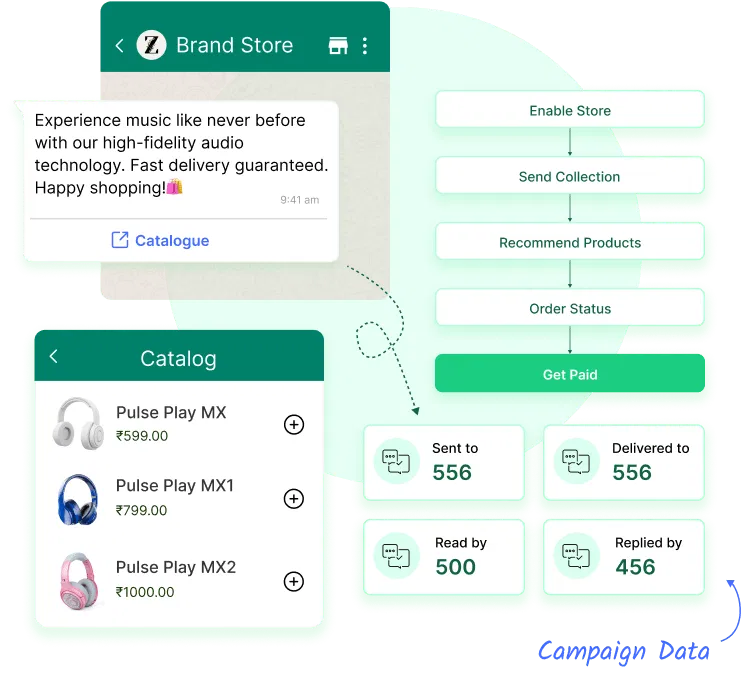
If you're still on the fence about voice, consider the efficiency of a WhatsApp Store. When customers can browse your WhatsApp catalogue and buy directly in the chat, they don't need to call you.
Automation handles the "boring" stuff:
- Greeting & Triage: Identifying why the customer is writing.
- Order Status: Fetching data from your Shopify or WooCommerce store instantly.
- FAQ Bots: Answering common questions 24/7.
This leaves your human agents free to handle the things that actually matter, making your team feel less like a "call center" and more like a high-performance success team.
6. The Best of Both Worlds: A Hybrid Strategy
The most successful brands we work with at WebMaxy don't choose one or the other. They use a Hybrid Strategy.
- Automation First: Every query starts with a bot to gather info.
- Chat Second: If the bot can't solve it, a human agent takes over in the dashboard.
- Voice as an Escalation: If the chat gets too complex, the agent offers to jump on a quick WhatsApp call.
This keeps your costs low and your customer satisfaction high. You’re giving them the speed of a bot and the heart of a human when they truly need it.

Conclusion
So, do you really need WhatsApp Voice Calling? If you’re using it as your primary support channel, probably not. It’s a "nice-to-have" for specific high-touch moments, but it's a terrible foundation for a scaling business.
Your foundation should be a robust WhatsApp Business API setup with a multi-agent dashboard and smart automation. This gives your team the tools to be faster, smarter, and ultimately, more profitable.
Ready to see how a multi-agent dashboard can transform your support? Book a demo with WebMaxy today!
FAQ
Q: Can I use WhatsApp Voice on the standard Business App?
A: Yes, but it only works on one device at a time. If you want a whole team to handle calls and chats, you need a platform like WebMaxy that uses the WhatsApp Business API.
Q: Does voice calling cost more?
A: WhatsApp calls are data-based (VoIP), so there aren't traditional per-minute phone charges, but they do consume your agents' most valuable resource: time.
Q: Can I record WhatsApp Business calls?
A: Recording calls on the standard app is difficult. However, with professional API integrations and contact center tools, recording and logging are much easier to manage for quality assurance.
Q: Is chat really faster than voice?
A: For simple queries, yes. A bot can answer an "order status" query in 2 seconds. A human on a phone might take 2 minutes just to greet the customer and find their order number.
Q: Can WebMaxy help me set up automation?
A: Absolutely! We specialize in automated workflows and AI chatbots that do the heavy lifting for you, so your team can focus on closing deals and solving big problems.

Adam Wilson
Adam Wilson comes with an experience of 12+ years in the IT industry. As a Customer Success Manager, he has been researching and trying to understand the customers’ behavior in different scenarios. He has also studied human psychology to relate it to the purchase journey of the customers. His published books on customer psychology and behavior have received many honors and awards from various enterprises.